
Durian Across Two Suns
A design-science case study of an AI-augmented method for culinary development and the conservation of indigenous food technique
James Won
French Borneo. Adjunct Professor, Taylor's University and Taylor's Culinary Institute, Subang Jaya
Atelier of Affinities, Residence of France, Kuala Lumpur · 11 June 2026
Abstract
This paper presents a single instrumental case study of PARA, a structured, AI-augmented method for the development of fine-dining menus in the idiom its author calls French Borneo: the study, extraction, and application of indigenous Bornean food technologies through French, Japanese, and modernist technique. The study is written in the design-science register. PARA is treated as the designed artefact, an instantiation that embeds a method and a set of governing constructs, and a single degustation, Atelier of Affinities: Durian Across Two Suns, is treated as the demonstration through which the artefact is exercised end to end. The distinction between demonstration and summative evaluation is held throughout, and is the paper's principal methodological commitment: the menu was genuinely executed for an ambassadorial dinner, food-led, while its full development trace, including a beverage flight, is presented as a declared exemplar of the method rather than as a record of measured guest outcomes. The case is read against four design objectives, restated as design principles, and yields four analytical findings: that a staged pipeline externalises and disciplines culinary creativity in a manner consistent with the documentation practices of the contemporary haute-cuisine avant-garde; that conservation can be pursued through the transfer of technique rather than the reproduction of dishes, in keeping with the processual turn in heritage scholarship; that varietal specificity, here two cultivars of a single fruit, can serve as the organising logic of a whole menu; and that an explicit verification gate offers a workable governance discipline for AI-augmented practice. The paper closes with the limits of a demonstration case, and with the transferability such a case can and cannot claim.
Keywords: culinary creativity; design science research; case study; gastronomy; intangible cultural heritage; indigenous food knowledge; menu development; durian; fermentation; AI-augmented practice
1 Introduction
Indigenous Bornean foodways carry a body of technical knowledge, of fermentation, of enzymatic transformation, of the edible biodiversity of river, forest, and highland, that is transmitted by practice and held by communities rather than by written record. Knowledge of this kind is vulnerable in a way that a recipe in a book is not. When the practitioners who hold it age, and the conditions that sustained the practice change, the technique can be lost even where the dish it produced survives in name. Heritage scholarship has reached a similar recognition from another direction: the safeguarding of food culture, in the framing adopted by UNESCO in 2003, attends to living processes and practices rather than to fixed objects or named products (UNESCO, 2003).
This paper asks how a chef working at the fine-dining register might engage that body of indigenous technique in a way that conserves it as living practice rather than embalming it as a museum dish, and how the creative and operational work of doing so might be made explicit enough to be taught, audited, and repeated. It does so by examining a particular method, PARA, and a particular instance of its use. PARA is a structured, AI-augmented development environment built and operated by the author to take a menu from a brief to a costed, plated, service-ready degustation through a defined sequence of stages. The instance examined here is a five-course chef's table built on a single hero ingredient, durian, read through two of its cultivars.
The study makes a deliberate methodological choice. It is written as a design-science case study (Hevner et al., 2004; Peffers et al., 2007), in which PARA is the designed artefact and the durian menu is the demonstration through which the artefact is exercised. The choice matters for honesty as much as for rigour. A demonstration shows that an artefact can be used to address the problem it was built for; it is not the same as a summative evaluation, which would compare the artefact's stated objectives against measured outcomes of use (Peffers et al., 2007). This paper demonstrates; it does not yet evaluate. The menu was cooked, but no guest survey, sensory panel, or controlled comparison was run, and none is reported. Where figures appear they are illustrative estimates, identified as such. The contribution offered is the documented method and the worked example, read analytically against the objectives the method sets itself.
The companion evaluation protocol referred to throughout bounds the claims made here and signposts where they would be tested; it does not support them. No result from that protocol exists, because the protocol has not been run. This paper therefore stands on its demonstration value alone, and is written to be read that way.
Three research questions organise the study. RQ1: what does a staged, AI-augmented pipeline do to the work of culinary development that an undocumented creative process does not? RQ2: can the engagement of indigenous technique within such a pipeline be characterised as conservation, and on what grounds? RQ3: what disciplines does an AI-augmented method require if its outputs are to be trusted by practitioners and scholars?
The remainder of the paper situates the work (Section 2), sets out the case-study design, its design principles, and its evidentiary status (Section 3), describes the demonstration in full (Section 4), reports the analysis against the design objectives (Section 5), discusses the contribution and its transferability (Section 6), states the limits of a demonstration case (Section 7), and concludes (Section 8).
2 Background and conceptual framing
2.1 French Borneo: conservation through technique
The author works in an idiom he names French Borneo. Its discipline is a three-movement one: study, extract, apply. Indigenous Bornean food technologies are studied for what they do, how a fermentation builds acidity and savour, how an enzymatic cure firms a flesh, how a biodiversity of herbs and barks is used to season and to preserve, and the underlying technology is extracted from the dish that historically carried it and applied, through French, Japanese, and modernist technique, to contemporary eating.
The distinction between technology and dish is the conceptual centre. The idiom does not set out to reproduce a classical indigenous recipe in fine-dining dress. It sets out to carry forward the technique that the recipe encodes. The working illustration is fermentation: the Iban and Orang Ulu preserve fish and meat by lacto-fermentation in rice and salt, a method known across Borneo under names such as kasam; the Malay and Iban kitchens ferment durian into tempoyak. What French Borneo extracts is not the specific historical dish but the fermentation technology, the controlled acidification, the salt ratio, the anaerobic hold, which can then be applied to a new composition while the knowledge it embodies is kept in use.
This stance has a counterpart in heritage scholarship. The 2003 UNESCO Convention for the Safeguarding of the Intangible Cultural Heritage marked a shift of attention from tangible cultural objects to intangible cultural processes, and from preservation toward safeguarding as the keeping-alive of a living practice (UNESCO, 2003). It is a point often misread in popular accounts: the Representative List safeguards practices and the knowledge that sustains them, the gastronomic meal of the French, the traditional dietary cultures of the Japanese, rather than specific dishes or branded products. A conservation that keeps a technique in working use, rather than fixing a dish in aspic, is therefore not a marginal interpretation of safeguarding but close to its centre. French Borneo's claim is that the fine-dining kitchen can be one site of that keeping-alive, provided the technique, and not merely the name, is what is carried.
Two cautions must be entered at the outset, because the claim is easy to overstate. First, conservation through technique is, at this stage, a design rationale and an aspiration, not a demonstrated outcome: the present case engaged a technique and named its source, but no knowledge-holder took part in it, no transmission was measured, and the case cannot show that anything was in fact conserved. Second, to carry a community's technique into a fine-dining composition is to make a claim on that community's knowledge, and that claim is properly governed. Its realisation depends on free, prior, and informed consent and on the fair sharing of benefits, in the terms set by the Nagoya Protocol for access to genetic resources and the associated traditional knowledge (Secretariat of the CBD, 2011), by the CARE Principles for Indigenous Data Governance, with their insistence on the community's authority to control and on collective benefit (Carroll et al., 2020), and by the rights affirmed in Article 31 of the United Nations Declaration on the Rights of Indigenous Peoples (United Nations, 2007). The method can keep a technique in use and name its source; it cannot, by itself, constitute that consent. Section 5.2 returns to this, and the companion evaluation protocol places the communities, not the chef, in authority over the judgement of fidelity.
2.2 PARA as a designed artefact
PARA is the instrument through which the author develops menus in this idiom. For the purposes of this study it is treated as a designed artefact in the design-science sense. Hevner et al. (2004) classify the outputs of design science as constructs, models, methods, and instantiations; PARA is an instantiation that embeds a method, a defined development sequence, and a set of constructs that govern what the method may and may not do.
The method is an eleven-stage run, from the setting of constraints through to a costed and service-ready output. The governing constructs are a canon: rules that the development must observe and that hold across every menu. Two are material to the case at hand. The first is a protein-class rule that fixes the stock base deterministically: meat preparations take a chicken stock, enriched where appropriate by the roasted bones of the hero protein; non-meat preparations take a kombu-and-bonito dashi; and these bases do not cross. The second is a standing exclusion, no pork, no beef, no veal, that holds regardless of brief. The canon is not advisory. It is the part of the artefact that prevents the method from producing a plausible-looking but incoherent result, and it is enforced rather than merely stated.
One claim must be withheld. PARA is sometimes described, in the author's roadmap, as a method that will learn and compound across menus. That capability is a design intention, not a present property of the artefact, and it is not claimed here. What is demonstrated in this paper is the staged method and its governing canon as they presently operate, not a learning system.
2.3 Situating the work in gastronomy scholarship
The documentation of a creative culinary process is not new to the field, and the most instructive precedent is elBulli. Across three decades, Ferran Adrià and his team built an elaborate apparatus for recording, classifying, and analysing their own creative work, and that apparatus, not only the dishes, is now understood as the restaurant's lasting contribution (Opazo, 2012). Adrià's later codification, the Sapiens method, proposed to decode a creative discipline by interrogating the what, how, when, where, who, for-what, and why of each of its processes, moving from the general to the concrete; the published volumes A Day at elBulli and elBulli 2005-2011 are, among other things, demonstrations of that documentary turn (Adrià, Soler and Adrià, 2008, 2014). Opazo's study, published in this field's journal of record, shows that the systematic documentation of practice had effects inside the organisation as well as outside it: it created a shared platform of understanding that shaped how the kitchen worked (Opazo, 2012).
Two features of the elBulli precedent bear directly on the present case. The first is the principle that documentation is itself a creative instrument, not merely a record kept after the fact. PARA's staged pipeline is an instrument of exactly this kind, with the difference that its documentation is generated in the course of development rather than reconstructed afterwards. The second is Adrià's late practice of building a tasting as a sequence, or meditation, on a single theme, a season, a country, a single ingredient. The durian menu examined here is a meditation of this kind, with a particular refinement: its single ingredient is read through two cultivars, so that the meditation is conducted not on durian in general but on the specific difference between two of its varieties.
The present work departs from the precedent in three respects, which Section 6 develops: its telos is the conservation of indigenous technique rather than the establishment of a new culinary school; its development is augmented by a large-language-model system rather than by manual documentation alone; and it carries an explicit verification discipline, occasioned by the particular failure modes of AI-augmented work. The idiom also sits within a critical literature that this framing engages, because a conservation-through-technique claim is only as strong as its defence against the charge of appropriation: the construction and commodification of regional and national cuisines, the politics of culinary identity, and the heritagisation and authenticity debates in food studies. The claims of Sections 5.2 and 5.5 are written to be defensible against that literature, and the commercialisation tension it raises is addressed directly in Section 5.2.
2.4 Prior computational engagement with cuisine
PARA must be situated not only against the manual documentation of the avant-garde but against prior computational engagement with cuisine, which has taken two main forms. The first is idea generation by ingredient association, exemplified by computational food-pairing work grounded in the shared-compound hypothesis, and by the discontinued IBM Chef Watson, which proposed novel combinations but neither costed, governed, nor attributed them. The second is general large-language-model assistance, which will attempt the whole task but is subject to fluent, confident fabrication. PARA differs from both in kind rather than degree: it is a governed, attribution-aware method that carries a single menu from concept to cost under a deterministic canon and a verification gate. The novelty claimed is the assembly, not any one component.
2.5 What the system does and does not do
PARA is an AI-augmented method, and a reader is entitled to ask what the augmentation actually contributes. The division of labour across the eleven stages is uneven, and stating it guards against two opposite errors: crediting the system with the chef's judgement, and dismissing it as mere transcription. The chef sets the brief and the constraints, fixes the governing idea, assigns the cultivars, holds the canon, and takes every final judgement of taste; none of these is delegated. The system's work is of a different kind. It drafts options at each stage for the chef to accept, alter, or reject; it surfaces affinities and tensions for the chef to weigh; it generates the structured record as development proceeds rather than after it; and at the verification gate it assembles the assumptions and unconfirmed figures for checking. The system proposes and documents; the chef disposes.
What the present case cannot do is measure how much of the result is owed to the system, how much to the chef, and how much to the discipline of the staging itself. A skilled chef working to the same staged scaffold by hand might reach a comparable dossier; this case cannot tell, because it ran only one development, with the system in it, conducted by the person who built it. This is not a flaw to be concealed but a question to be handed on. The companion evaluation protocol is built around exactly it, isolating the system's contribution by comparing development with the system against development to the same scaffold without it. Until that study is run, the honest claim is narrow: that the method, with the system in it, produced this menu to this standard, not that the system is the cause of the standard.
2.6 Positionality
Because the integrity of a single-case design rests on the candour of its author, the author's position is stated here rather than left implicit. The author is the designer of PARA, the operator of the demonstration, the chef whose two decades of practice the French Borneo idiom encodes, and the analyst of this case. He also has an interest in the method's continued development. This concentration of roles is the principal threat to the study's validity. It is named here, treated as a standing limitation throughout (Section 3.5, Section 7), and answered structurally in the companion evaluation protocol, which removes the designer from the evidence by placing the method in other hands and the judgement of fidelity with the communities concerned. The reader is asked to weigh every finding below as the reading of one disciplined development by the person who built it, which is what it is, and no more.
3 Methodology
3.1 Research design
The study is a single-case, holistic, instrumental, demonstration case study. Each term is chosen.
It is a case study in Yin's sense: an empirical inquiry into a contemporary phenomenon within its real-life context, undertaken where the boundaries between the phenomenon and its context are not clearly separable (Yin, 2018). The phenomenon, an AI-augmented method for culinary development, cannot be examined apart from the context of an actual menu developed and cooked under real constraints, and the case study is the design suited to that condition.
It is instrumental in Stake's sense (Stake, 1995). The interest is not in the durian dinner for its own sake but in what the dinner allows one to understand about the method and the idiom that produced it. The case is, in Stake's terms, secondary to the issue it illuminates. An instrumental case of this kind does not licence statistical generalisation, and none is sought.
It is a demonstration in the design-science sense (Peffers et al., 2007). In the design-science research methodology, demonstration is the activity of showing that the designed artefact can be used to solve an instance of the problem it addresses; it may proceed by experimentation, simulation, proof, or case study. Demonstration is explicitly distinguished from evaluation, the later activity of observing and measuring how well the artefact supports a solution by comparing objectives against observed results. This study performs the demonstration activity. It does not perform the evaluation activity, and Section 7 holds that distinction to account.
It is holistic rather than embedded in Yin's sense at the level of the case, though the single case contains analytically separable sub-units, the eleven stages of the method, and the five courses of the menu, which are examined in turn (Yin, 2018).
In the terms of the Framework for Evaluation in Design Science Research, the present study is a formative, artificial-paradigm activity: it establishes that the artefact can be exercised end to end, and it locates the summative and naturalistic episodes, where quality, transferability, and conservation fidelity would be judged, in the companion protocol rather than performing them here. This paper is one point on an evaluation trajectory, not the whole of it.
3.2 Unit of analysis
The unit of analysis is PARA-as-instantiated-method, demonstrated through one menu. It is worth stating plainly what is and is not under study. The object of the study is the method and its governing canon; the menu is the vehicle of demonstration. A finding about the menu, that a given course holds together, that a pairing carries, is of interest only in so far as it is evidence about the method that produced it.
3.3 Design objectives and design principles
Demonstration is meaningful only against stated objectives; these function, in case-study terms, as the propositions that direct what evidence is gathered and how findings are interpreted (Yin, 2018). The artefact was built to meet four objectives. To sharpen the design-science contribution, each objective is paired below with the design principle the artefact embodies to meet it, stated in the established anatomy of aim, context and boundary, mechanism, and rationale, so that the principle, not the menu, is what a second instantiation would carry forward.
| Principle | Statement (implementer, aim, context, mechanism, rationale; with boundary) |
|---|---|
| DP1 Externalisation | For a chef or culinary educator developing a menu, to make culinary reasoning inspectable and teachable, in a register where method is ordinarily tacit and held by one practitioner, stage development so each decision is recorded as it is taken and constrains the stages that follow, because reasoning made inspectable as it is formed, rather than reconstructed afterwards, can be audited by a second practitioner and carried into teaching. Boundary: concerns the inspectability of reasoning, not the quality of the resulting dish. |
| DP2 Conservation through technique | For a kitchen drawing on indigenous or traditional technique, to keep that technique in living use rather than reproduce a historical dish, where the knowledge is community-held and any use makes a claim on it, extract the working principle of the technology and apply it to a new composition with attribution to the source community, because carrying technique rather than copying dishes is the processual form of safeguarding. Boundary: a mechanism for engagement and attribution only; it neither constitutes consent nor certifies conservation, which are community-held and governed by free, prior, and informed consent, the CARE Principles, and UNDRIP. |
| DP3 Coherence under a governing idea | For a developer carrying a single organising idea across a menu, to prevent that idea being lost between concept and plate, where downstream stages can quietly drift from it, fix the idea early and propagate it deterministically through arc, pairing, procurement, and costing, because an idea enforced by structure survives the development that a merely intended idea does not. Boundary: concerns coherence to the idea, not the merit of the idea itself. |
| DP4 Trustworthiness | For any AI-augmented developer whose output is service- or scholarship-facing, to prevent unverified or fabricated content reaching the output, where generative components fail by fluent, confident error, enforce a canon of deterministic constraints and a verification gate that withholds unconfirmed content before the work proceeds, because deterministic rules and an explicit verification pass convert a class of silent error into a caught one. Boundary: lowers and surfaces error; it does not make a generative method provably error-free. |
Table A. The four design principles, stated in the anatomy a second instantiation would carry forward.
To make the relevance and rigour of the design visible, Table B traces each field problem to the objective it motivates, the principle that answers it, and where it is tested.
| Field problem | Objective | Principle | Where tested |
|---|---|---|---|
| Menu development is slow and the standard lives in one head | O1 Externalisation | DP1 | Section 5.1; protocol Episode B |
| Indigenous technique is at risk and easily reduced to pastiche | O2 Conservation through technique | DP2 | Section 5.2; protocol Episode D |
| A single organising idea drifts as development proceeds | O3 Coherence | DP3 | Section 5.3 |
| AI-augmented tools fabricate fluent, confident content | O4 Trustworthiness | DP4 | Section 5.4; protocol Episode B |
Table B. Requirements traceability: from field problem to objective, design principle, and the evaluation that tests it.
3.4 Evidence base and its status
The evidence is documentary, and its status must be stated precisely, because the integrity of the study depends on it.
The menu was developed in PARA and cooked. It was served at an ambassadorial dinner at the French Residence in Kuala Lumpur, prepared across two sites, bulk work at Taylor's Culinary Institute, finishing and plating at the Residence, by a brigade of seven. That service ran food-led, under halal handling, with beverage stood down.
The development record examined here is the full PARA dossier for the menu, together with its companion production and logistics pack. This dossier exercises the method end to end, including the beverage and pairing stages, which were run in full as a demonstration of that subsystem of the method. The beverage flight described in Section 4 is therefore a declared exhibit of the method's pairing capability, not a record of wines poured on the night. The dossier states this on its face, and the present study repeats it: the inclusion of the flight is a demonstration of a subsystem, not a claim about the ambassadorial service.
Quantities, covers beyond the twenty actually served, costings, and timings in the dossier are illustrative estimates, realistic for a Kuala Lumpur durian season, but estimates, and identified as such throughout. No measured outcome of any kind is presented as a finding. There is no guest feedback, no sensory panel, no controlled comparison in this study, because none was conducted.
Construct validity is supported, in Yin's terms, by the use of multiple documentary sources and a chain of evidence from each claim back to its source (Yin, 2018). That support must not be overstated. The development dossier, the production pack, and the canon were all authored by the same hand, so they corroborate one another's authorship rather than independently witnessing the facts of the night. Genuinely independent corroboration would come from records the present study does not rest on, a brigade debrief, an execution log, dated plating photographs, and the Residence service record. Those of these that could be gathered are set out in Appendix D and are distinguished there from the author-authored dossier; the remainder are outstanding and would be gathered in any evaluation. The principal threat to construct validity, that the author is at once the designer of the artefact, the operator of the demonstration, and the analyst of the case, is named in the positionality statement (Section 2.6) and revisited in Section 7 rather than waved away.
3.5 Quality criteria
A demonstration case of this kind is judged by criteria appropriate to its design, not by the criteria of an experiment. Four are applied. Construct validity, as above, through corroborating documentary sources and an explicit chain of evidence (Yin, 2018). Analytical, not statistical, generalisation: the study does not generalise from one case to a population but offers, in Flyvbjerg's terms, the force of example, a single fully worked case serving as an exemplar against which other cases can be read (Flyvbjerg, 2006), and it claims this modestly, since a single demonstration authored by the artefact's designer is a weaker exemplar than a richly empirical paradigmatic case. Positioning of the contribution, following Gregor and Hevner (2013), as the presentation of a designed method and its demonstrated instantiation, with the knowledge residing in the documented artefact and the analytical reading of its use rather than in measured effect. Reflexivity: the designer-as-analyst condition is treated as a standing limitation and named wherever it bears on a finding.
4 The case: Atelier of Affinities, Durian Across Two Suns
This section describes the demonstration. It follows the development as PARA staged it, condensed but faithful to the dossier, and presents the menu in full. It is, in the language of the case-study method, the thick description against which the analysis of Section 5 is set.
4.1 Brief and constraints
The brief was a five-course chef's-table degustation with durian as the hero, for twenty covers at the French Residence in Kuala Lumpur, hosted by the Ambassador of France. Four savoury courses and one dessert; a two-site execution, with bulk preparation at Taylor's Culinary Institute and finishing at the Residence; a brigade of seven, comprising the author, two lecturers, and four final-year students. The standing canon applied: no pork, no beef, no veal. Shellfish and fish were present and declared at booking.
The constraint-setting stage also fixed the canon for this menu. The four non-meat courses take a kombu-and-bonito dashi as their base; the one meat course takes a chicken stock enriched by the roasted carcass of its own duck; the bases do not cross. The cultivar is canon here too: the two durian varieties are not interchangeable, and each course names the one it is cooked under. Bario cinnamon, a native Bornean cinnamon stewarded by the Kelabit highlands, and premium vanilla are drawn from a standing pantry.
Food-safety and dietary governance are stated here because a method that documents a development to a professional standard must document its safety basis to the same standard. The fermentation was controlled to a clean sour at or below pH 4.5, below the threshold conventionally applied to acidified foods as the control point for Clostridium botulinum. The cured greater amberjack was prepared from sashimi-grade fish under cold-chain control; allergens, principally shellfish and fish, were declared at booking; and the service ran under halal handling throughout, across both the bulk site and the Residence.
4.2 The governing idea: two suns
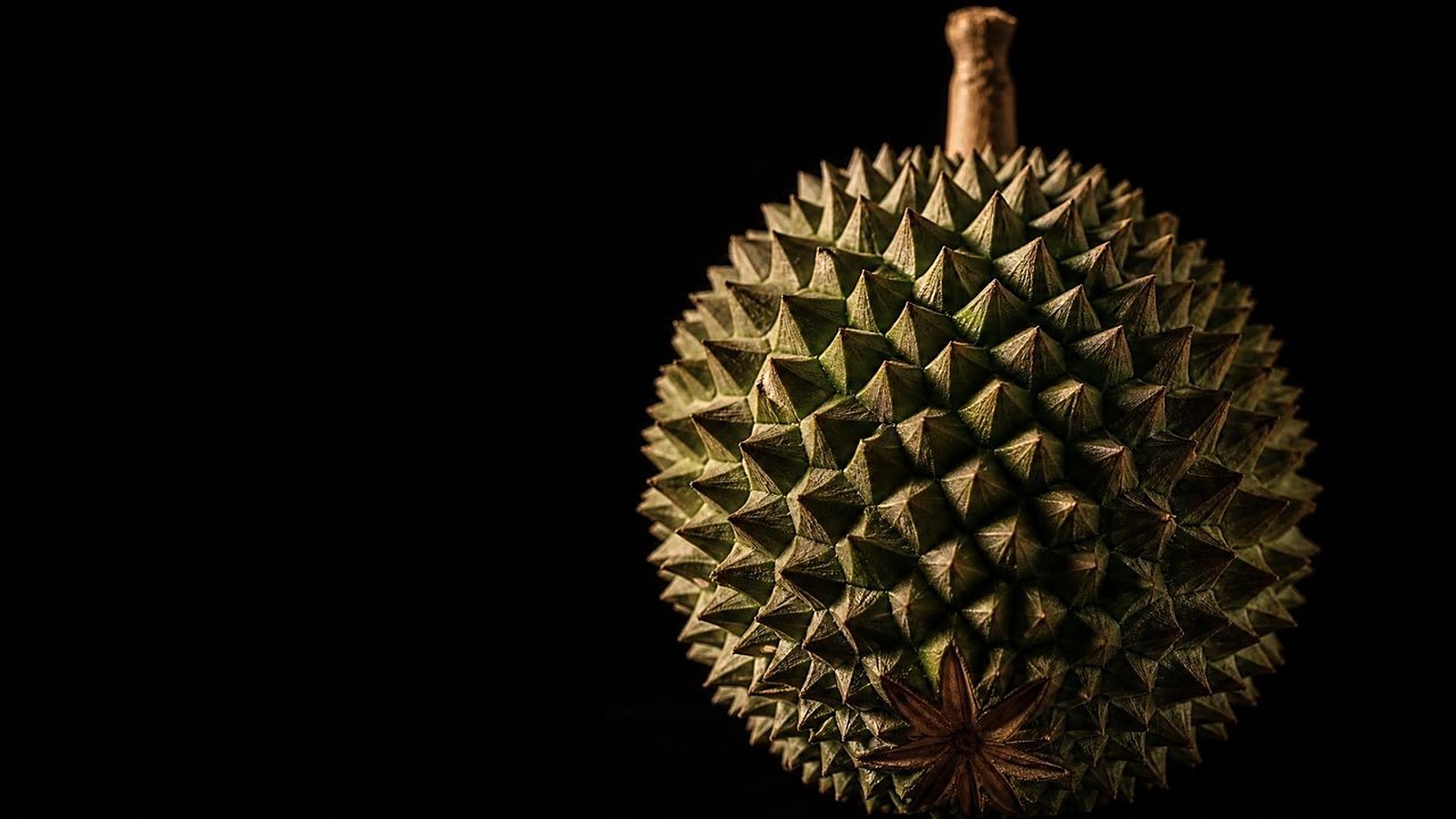
The organising idea is that durian is not one flavour. The menu is built on the difference between two cultivars, treated as two distinct registers. Musang King is the savoury register, sulphurous, given to ferment, cream, and smoke, and it lights the courses that ferment, enrich, and smoke the fruit. Black Thorn is the sweet register, cleaner, caramel-edged, floral, and it lights the courses that caramelise the fruit over fire and that present its sweetness whole at the close.
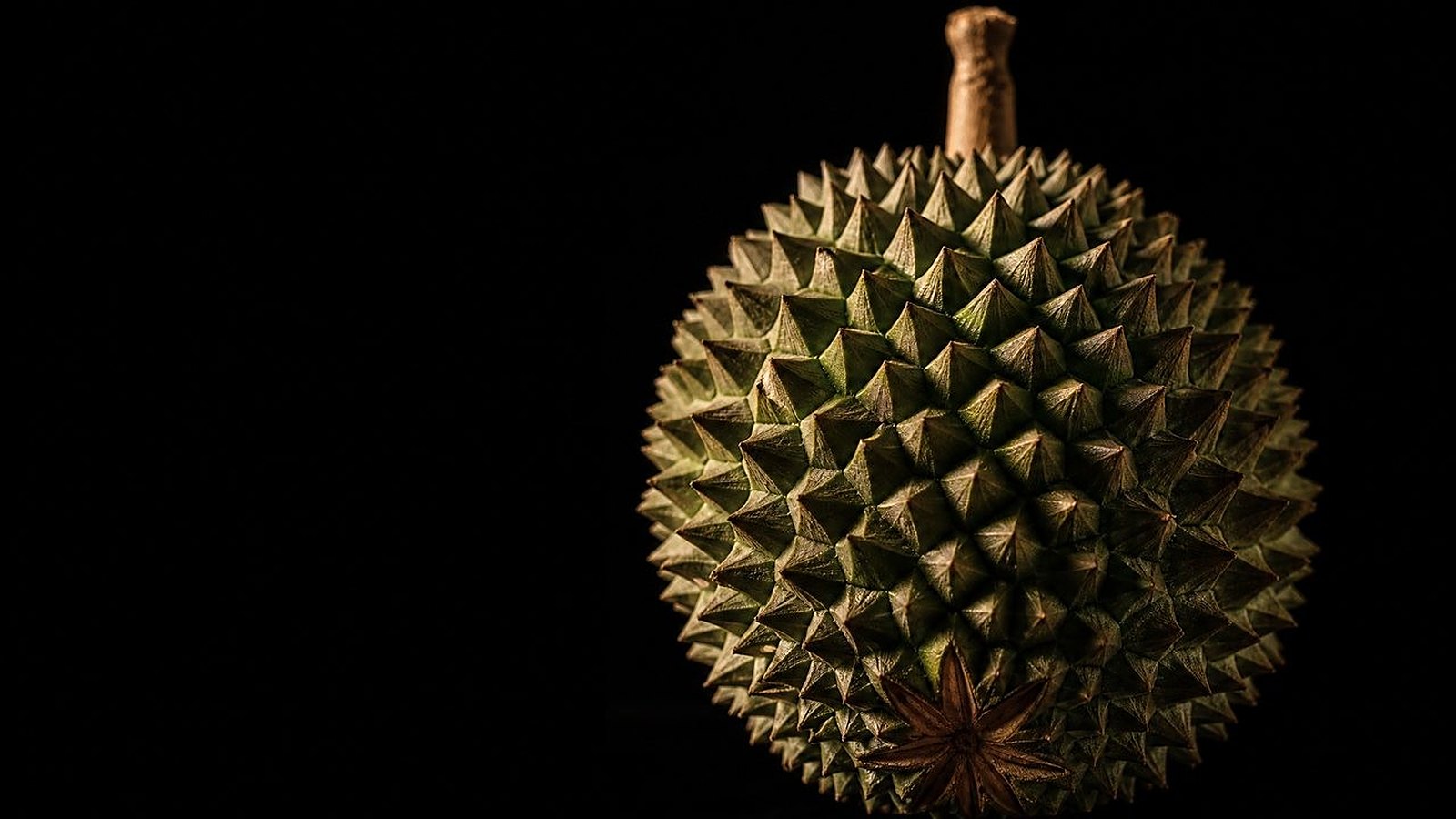
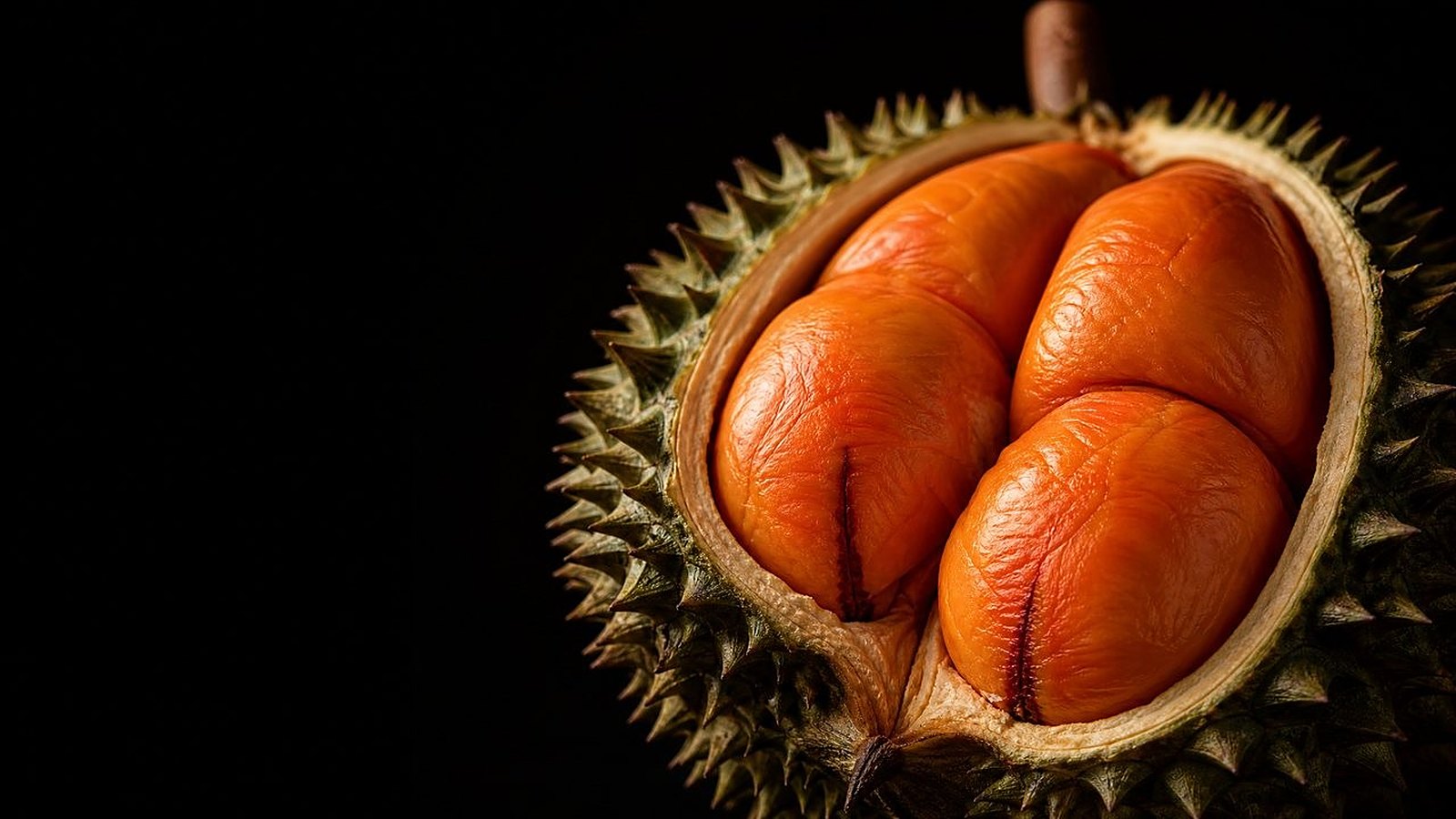
The single hazard in carrying one ingredient across an entire menu is not flavour but fatigue. Lead with the fruit's sweetness and the palate has nowhere left to travel. The architecture therefore withholds sweetness until the last course and moves the fruit through five states, fermented, fresh and creamy, caramelised, smoked, and finally pure and sweet, so that each course meets a durian the guest has not yet tasted. The cultivar is chosen to the state rather than used interchangeably, and this single decision propagates through the arc, the pairing, the procurement, and the costing. It is the governing idea of objective three made concrete.
Two notes of discipline belong here. The flavour descriptors used throughout, sulphurous, toffee-edged, floral, lifted, are the practitioner's lexicon, offered to convey intent, and not the validated vocabulary of quantitative descriptive analysis, which the descriptive panel specified in the companion protocol would establish. And the physico-chemical claims that follow, that Musang King turns sulphurous over direct heat where Black Thorn caramelises clean, and that durian's sulphur and fat flatten tannin and oxidise delicate aromatics, are reported as the practitioner's observations under service conditions.
4.3 The eleven-stage demonstration trace
PARA ran the menu through eleven stages. The trace below is the demonstration record, condensed; the full per-stage record is given in Appendix B.
Stage 0, Constraints. Covers, venue, host, two-site model, canon, exclusions, allergens, and sourcing fixed, as in Section 4.1.
Stage 1, Beverage. The flight was engaged and led from the front, on the reasoning that durian is among the most difficult heroes to pour against: its sulphur and fat flatten tannin and oxidise delicate aromatics, so the productive directions are high acidity, low tannin, and either residual sugar or effervescence to lift the fat and reset the palate. The two-sun logic governs the flight as it governs the plate. (The flight is the declared exhibit of Section 3.4.)
Stage 2, Architecture and arc. The five states were sequenced to climb from a savoury, fermented opening through a fire course to the roast, with the dessert holding the only pure sweetness. Palate resets were assigned deliberately: between the warm custard and the grilled scallop none was placed, both being warm and ascending, while the flight's acidity and effervescence carried the resets elsewhere.
Stage 3, Palette. Each course's flavour balance was set: sour and saline at the opening, round and marine in the custard, char and citrus over the fire, roast and smoke in the main, and a lifted sweetness at the close, with calamansi cutting the fat.
Stage 4, Structure. Each course was resolved into its components, the fermented emulsion and cured fish of the opening, the steamed custard and crab of the second, and so on, with the cultivar named for each.
Stage 5, Recipes. Each component was specified to its target: weight, temperature, time, pH, cut, yield, and hold, with a par level for service. The two structural bases, an awase dashi for the non-meat courses and a duck jus for the meat course, were specified in full. The fermentation was specified to a controlled acidification of the durian to a clean sour at or below pH 4.5 over four to five days.
Stage 6, Pairing finalisation. The flight was finalised course by course, each match carried by a named axis, a shared aromatic family, a matched weight, or a structural cut, and the matches declared as culinary judgements rather than as scores from a pairing database.
Stage 7, Hallucination gate. Every assumption and every estimated figure still to be confirmed was listed and flagged. This stage is the governance mechanism of objective four, and Section 5.4 returns to it.
Stage 8, Plating. Each plate was composed.
Stage 9, Market list. The procurement was drawn from the recipes, with the durian sourced to grade at its July peak and the indigenous pantry items distinguished from standard stock.
Stage 10, Costings. The menu was costed at illustrative season rates, the cultivar decision flowing through to the procurement of two grades of fruit.
4.4 The menu
Table 1 sets out the menu as developed. The full component breakdown and the two base preparations are given in Appendix A.
| Course | Sun (cultivar) | Durian state | Principal technique | Protein class / base |
|---|---|---|---|---|
| I. Tempoyak, cured sériole, kombu | Musang King | Fermented, sour, savoury | Lacto-fermentation and cure | Non-meat / awase dashi |
| II. Savoury durian chawanmushi, mud crab | Musang King | Fresh, fat and body | Steamed custard | Non-meat / awase dashi |
| III. Binchotan scallop, caramelised durian, charred lime | Black Thorn | Caramelised, toffee-edged | Live-fire grill | Non-meat / dashi glaze |
| IV. Roast duck, durian-husk smoke, durian jus | Musang King | Enriching fat and smoke | French roast and sauce work | Meat / chicken stock with roasted duck carcass |
| V. Black Thorn parfait, Bario cinnamon, calamansi | Black Thorn | Pure, sweet, at peak | Aerated and frozen | Dessert |
Table 1. Atelier of Affinities, Durian Across Two Suns: the five courses.
The opening ferments Musang King into a tempoyak emulsion set against lightly cured greater amberjack and a clear kombu gelée, with no sweetness anywhere. The second reads the same cultivar as cream, folded through a steamed awase custard with picked mud crab. The third turns to Black Thorn, caramelised in the pan to a toffee depth that takes the fire without turning sulphurous, where Musang King would fight it, against a hard-seared scallop and charred lime. The fourth returns to Musang King as a foie-like enrichment in a duck jus built on the bird's own bones, with the fruit's husk used to smoke a vegetable and Bario cinnamon warming the sauce from behind. The close shows Black Thorn whole, the cultivar whose clean, floral sweetness rewards being presented at its peak, with Bario cinnamon and vanilla for warmth and calamansi for the acid that keeps the finish clean.
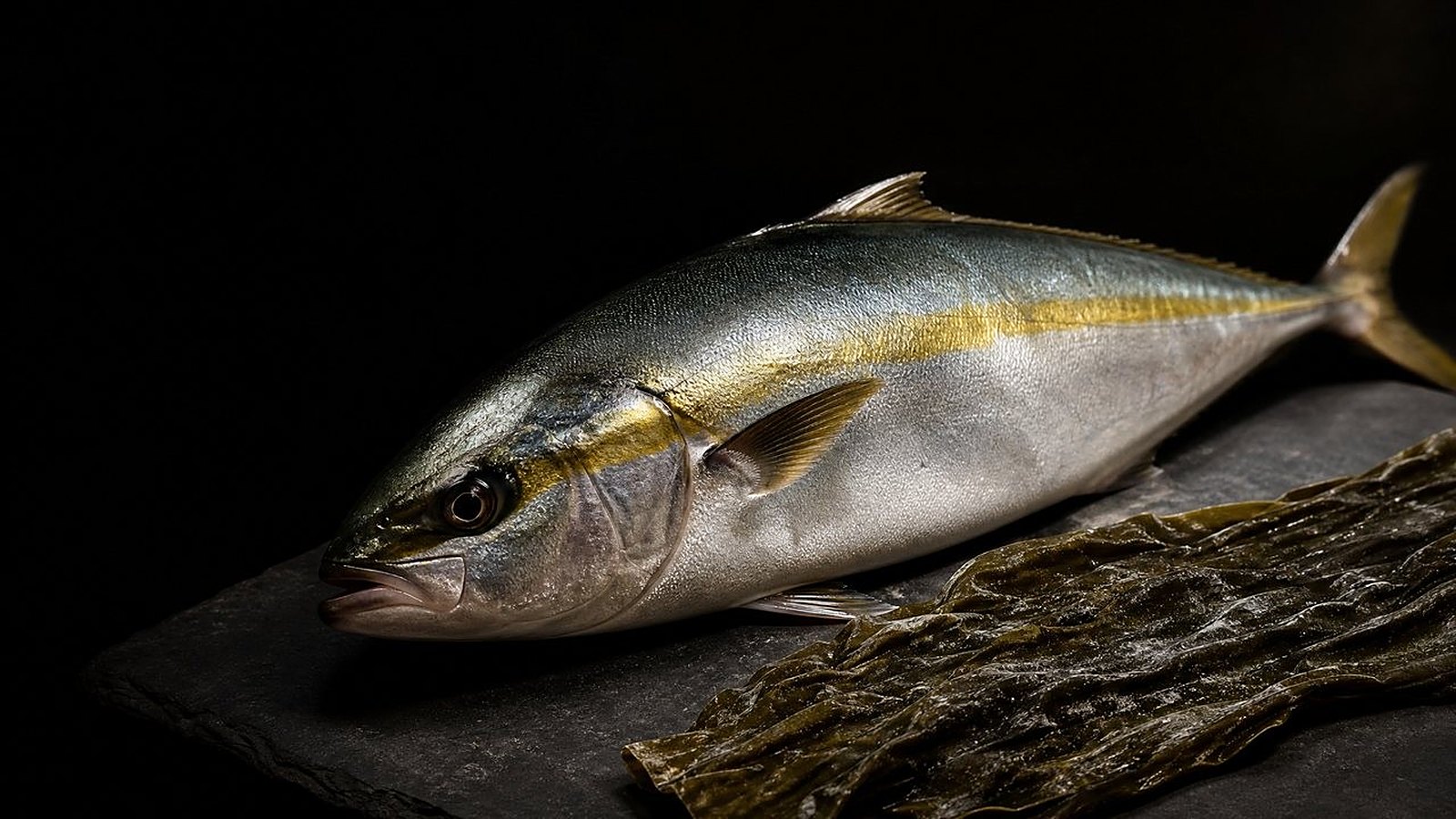
I, Tempoyak (Musang King)
© 2026 James Won
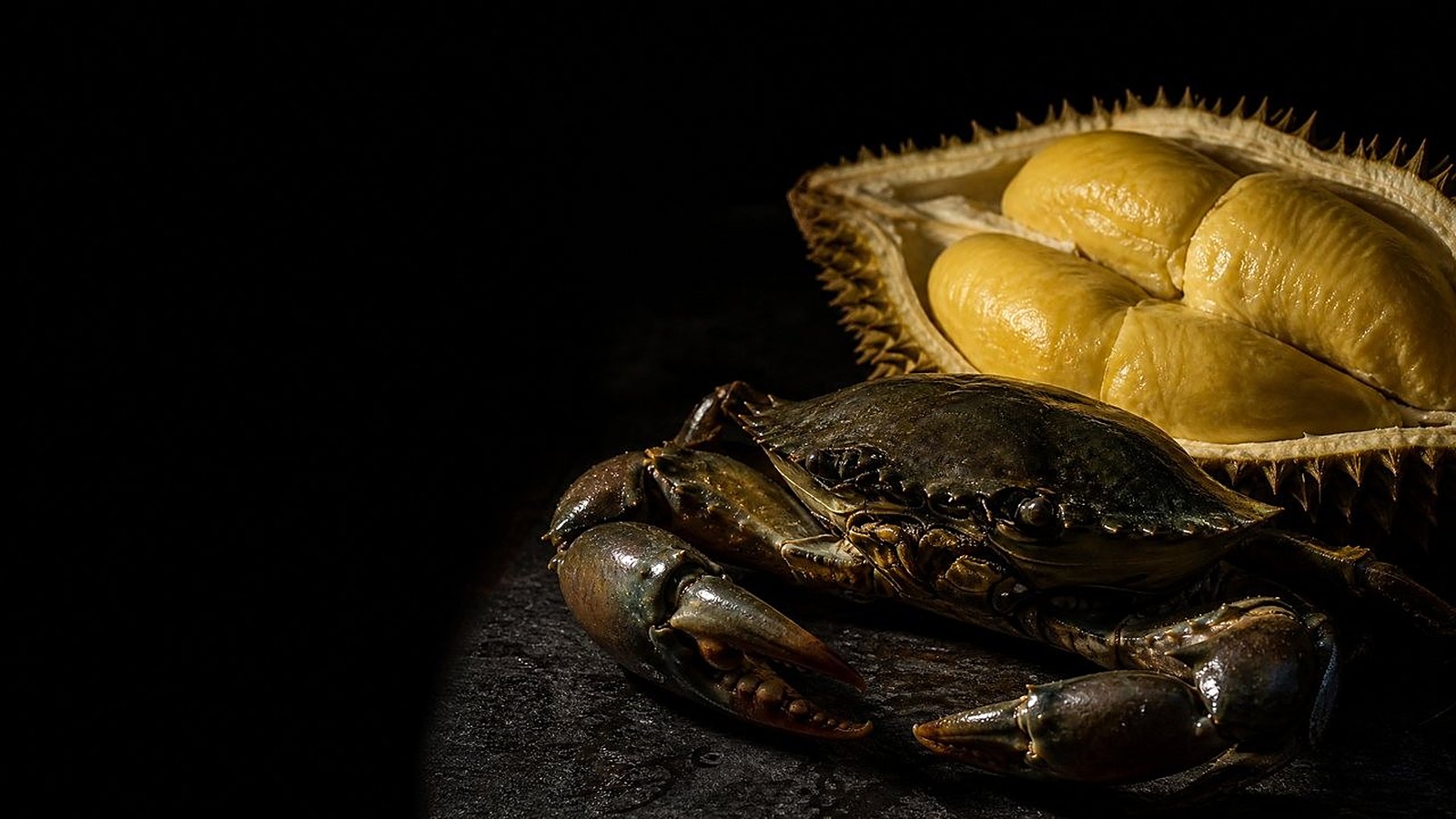
II, Chawanmushi (Musang King)
© 2026 James Won
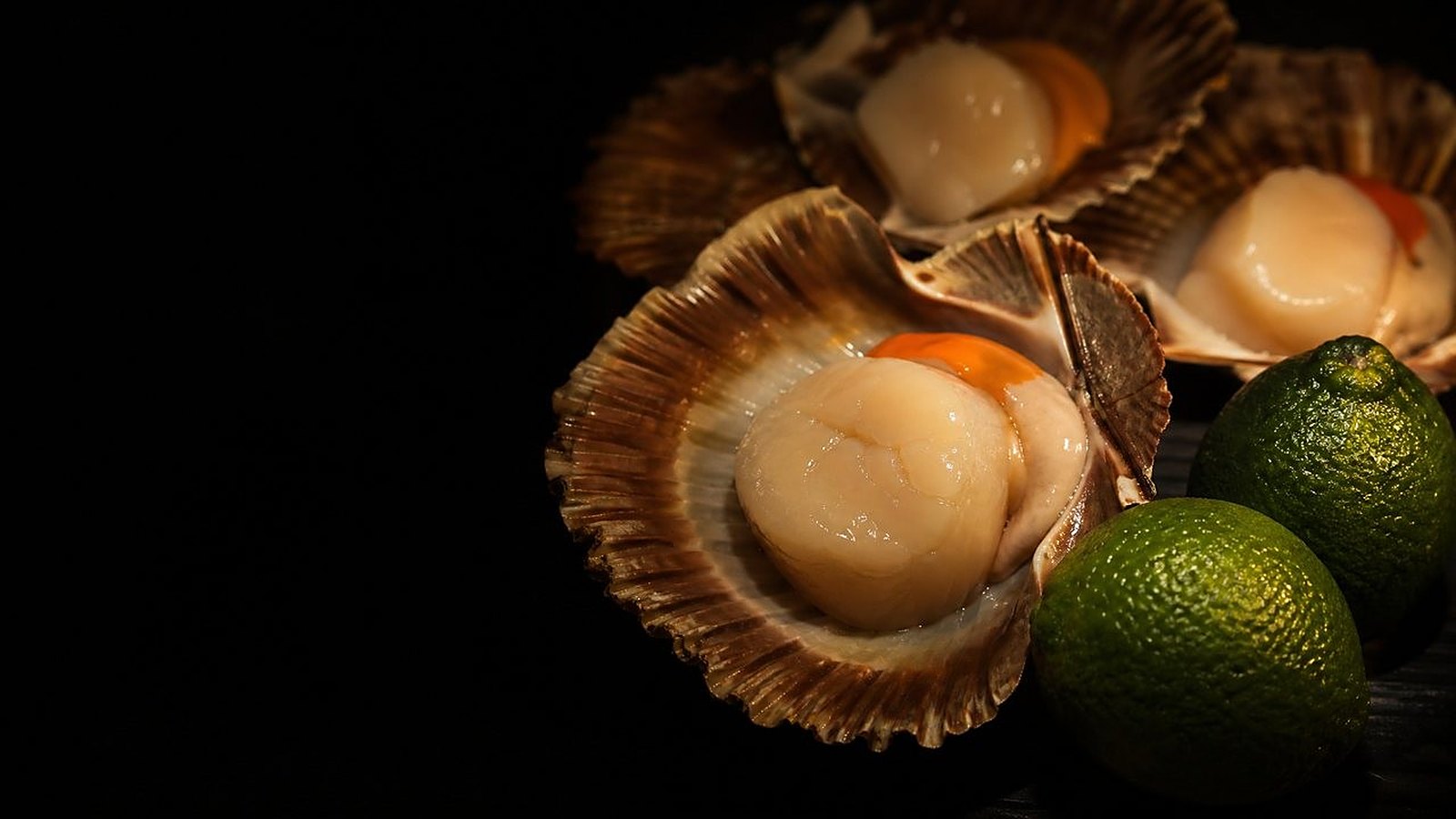
III, Scallop (Black Thorn)
© 2026 James Won
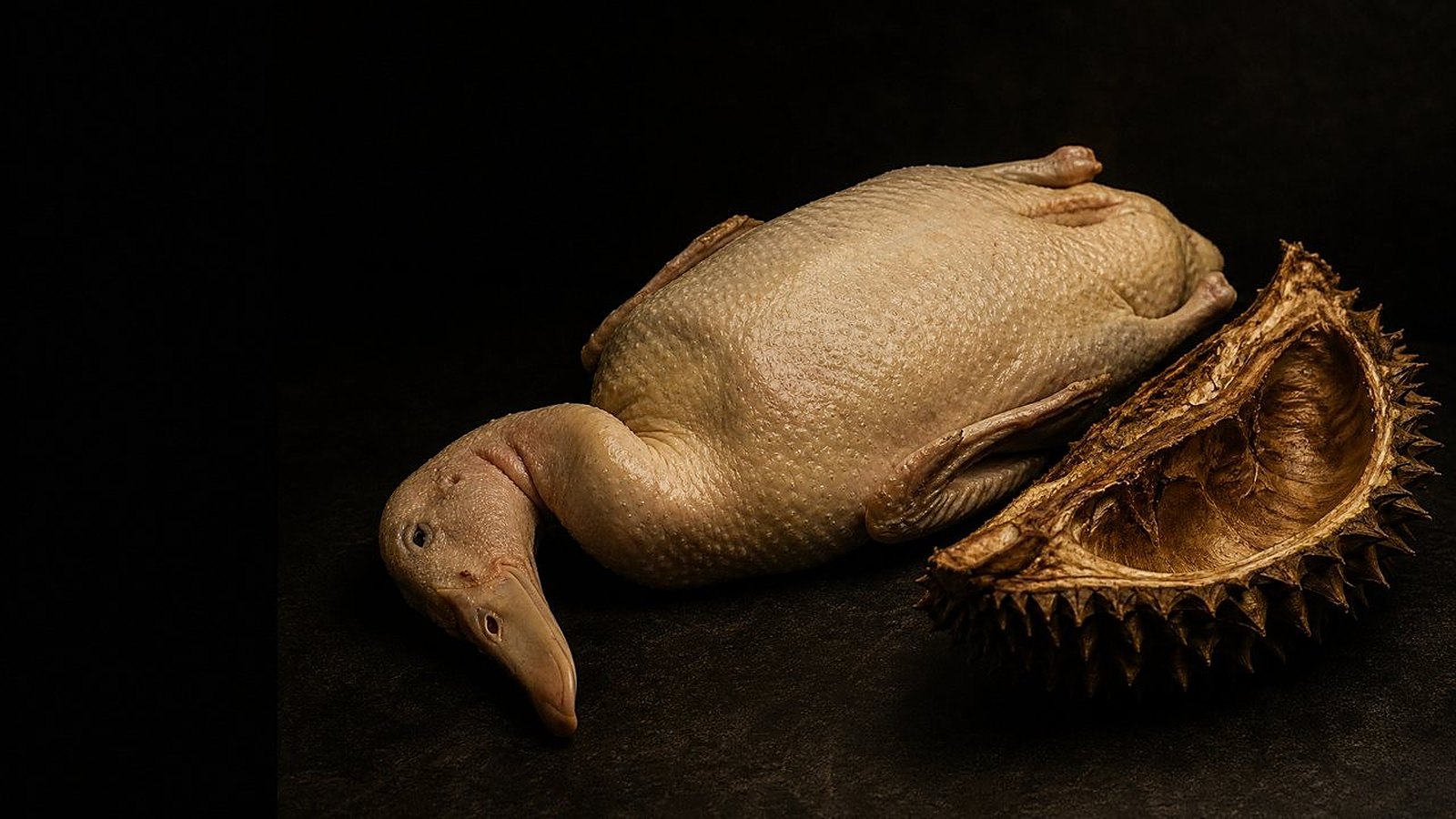
IV, Duck (Musang King)
© 2026 James Won
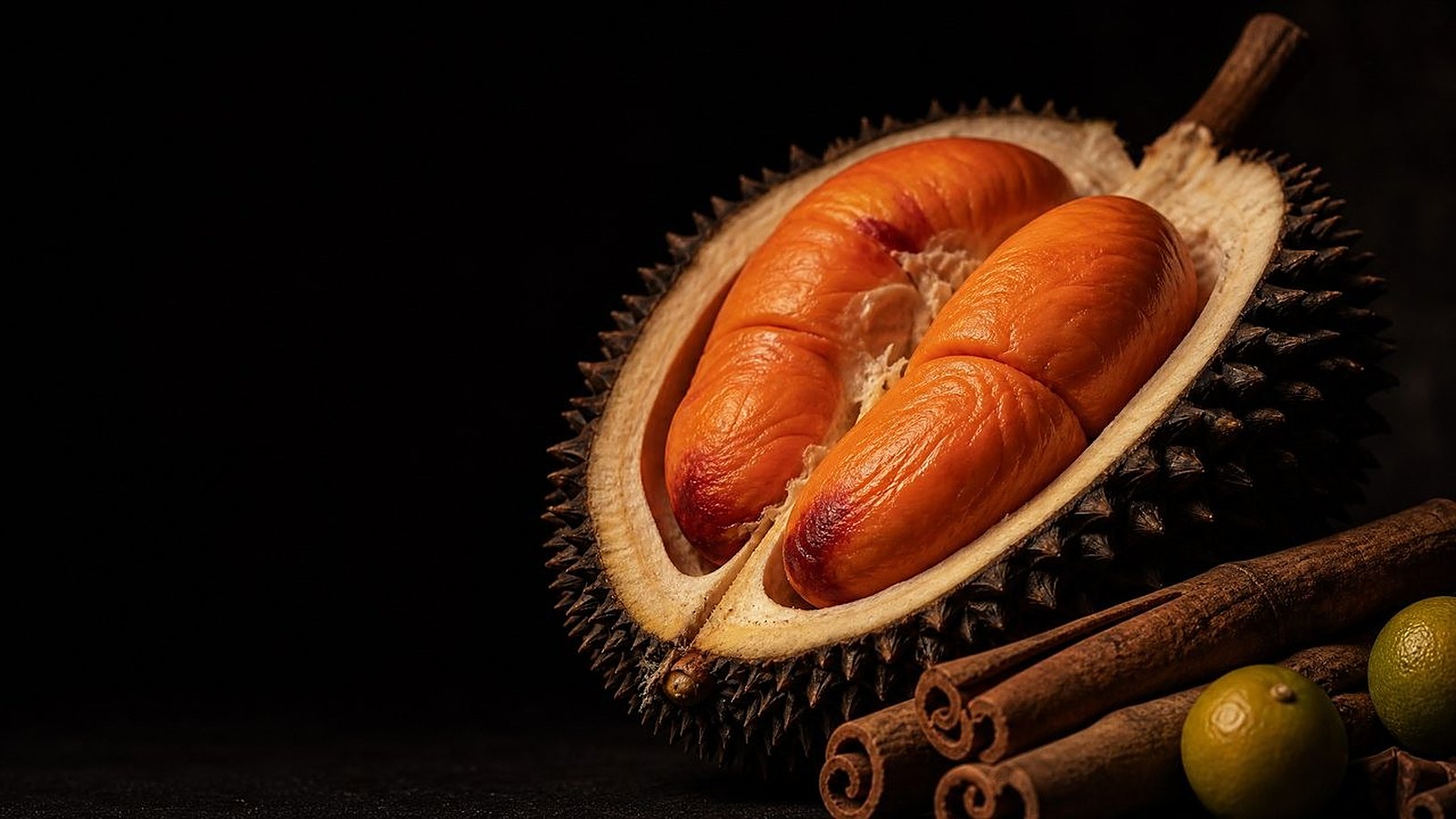
V, Parfait (Black Thorn)
© 2026 James Won
5 Analysis
This section reads the demonstration against the four design objectives of Section 3.3. Each finding is a statement about the method, evidenced by the menu, and bounded by the demonstration's evidentiary status.
5.1 Externalisation of the creative process
The first objective was that the method should make the reasoning of development explicit and inspectable. The eleven-stage trace shows how it does so. A decision taken early, that durian's sweetness must be withheld to the close, does not remain a private intuition but is recorded at the architecture stage and then constrains every later stage: it determines the sequence of states, the assignment of cultivars, the points at which the palate is reset, and the structure of the flight. The reasoning is available for inspection, and a second practitioner could interrogate it stage by stage.
This is the externalisation that the documentation tradition in haute cuisine identified as creatively generative rather than merely administrative (Opazo, 2012). The difference PARA introduces is one of timing. At elBulli the documentation was, in large part, a record assembled around the creative act; in PARA the staged record is produced in the course of the act and constrains it as it proceeds. The pipeline is not a transcript of a decision already made but the medium in which the decision is made and held to its consequences. For a discipline in which method has historically been tacit and resident in a single chef's judgement, the capacity to externalise that judgement into an inspectable sequence is the first contribution the case demonstrates.
5.2 Conservation through technique
The second objective was that the method should engage indigenous technique as living practice. The opening course is the clearest evidence. Its foundation is tempoyak, the fermented-durian condiment of the Malay and Iban kitchens. What the course carries forward is not the historical condiment served in its traditional setting but the fermentation technology the condiment encodes: a controlled lacto-acidification of durian flesh, specified to a salt ratio and held anaerobically to a target acidity. That technology is then applied to a new composition, an emulsion set against cured fish and a kombu gelée, in which it does work it has not historically done.
This is the study-extract-apply movement of Section 2.1 made concrete, and it answers the conservation question of the introduction. The technique is kept in use, which is the form of safeguarding the processual turn in heritage practice describes (UNESCO, 2003); it is not the dish that is reproduced but the knowledge that is exercised. The same logic governs the menu's use of Bario cinnamon, drawn from Kelabit highland stewardship, and the attribution of each technique to the community from which it comes is itself part of the discipline, not an afterthought. The finding, bounded as a demonstration finding must be, is that the method provides a workable mechanism for engaging indigenous technique without reducing it to either pastiche or quotation.
A caution belongs here, and it is the most important in the paper. The present case had no community participation: the technique was engaged and attributed, but no knowledge-holder judged whether it was faithfully carried, and the case therefore demonstrates a mechanism, not a conserved outcome. The heritage literature is right to warn that the heritagisation of food can shade into commercial capture, and attribution alone does not dissolve that risk. The safeguards lie outside the method and are not optional: the free, prior, and informed consent and benefit-sharing of the Nagoya Protocol (Secretariat of the CBD, 2011), the authority-to-control and collective-benefit of the CARE Principles (Carroll et al., 2020), and the rights of Article 31 of UNDRIP (United Nations, 2007). The companion evaluation protocol operationalises these in an episode governed by the communities themselves. The finding of this section is therefore bounded twice over: the method offers a workable mechanism for engaging indigenous technique without pastiche or quotation, but whether that engagement amounts to conservation is a question only the communities, over time, can answer.
A further obligation must be named, because the method demonstrated here is being developed toward wider and eventually commercial use. The use of a community-held technique in that context is not equivalent to its use in a purely scholarly one: the prospect of benefit raises the standard of consent rather than lowering it. The commitment, grounded in the collective-benefit and authority-to-control principles of the CARE framework (Carroll et al., 2020), is therefore explicit: no community-attributed technique is carried into any commercial deployment of the method ahead of free, prior, and informed consent and an agreed sharing of benefit; and the present demonstration, which preceded such consent, is treated as a development instance whose consent obligation is owed, not waived. Naming this does not discharge the obligation. It states it where it can be held to account.
A note on the form of attribution is owed for the same reason. The techniques here are attributed at the level of broad communities, tempoyak to the Malay and Iban kitchens, Bario cinnamon to the stewardship of the Kelabit highlands. Group-level attribution is a placeholder, not a settled form: it can flatten the internal diversity of a community and leaves the actual knowledge-holders unnamed. How a community is named, and by whom, is itself a matter for the community to decide under the authority-to-control principle (Carroll et al., 2020), and community-specified attribution is part of the consent process rather than a detail to be fixed by the author.
5.3 Coherence under a governing idea
The third objective was that a single organising idea should carry consistently through the whole development. The two-suns idea is the test, and it is an unusually demanding one because it rests on a distinction, between two cultivars of one fruit, that a less disciplined development would collapse. The case shows the distinction holding through every stage. At the architecture stage it assigns each of the five states to a cultivar. At the palette stage it explains why the fire course must be Black Thorn, whose cleaner sugar caramelises true where Musang King's would turn sulphurous over direct heat. At the pairing stage it splits the flight into the mineral, cutting whites of the savoury Musang King courses and the weightier, sweeter glasses of the Black Thorn courses. At the procurement and costing stages it resolves into two grades of fruit, separately sourced.
The finding is that the method can sustain an ingredient-led architecture: an organising idea drawn from the specificity of the hero ingredient itself, rather than from a theme imposed upon it, and propagated by the method's structure into every downstream decision. This connects the case to Adrià's practice of the single-ingredient sequence (Adrià, Soler and Adrià, 2014) while sharpening it: the meditation here is not on durian as such but on the difference within durian, and it is the method's staged structure that keeps that difference from being lost between concept and plate.
5.4 A governance discipline for AI-augmented practice
The fourth objective was trustworthiness, and it is the objective most particular to an AI-augmented method. The relevant mechanism is the verification gate at Stage 7, at which every assumption and every unconfirmed figure is listed and flagged before the development proceeds.
The discipline has a specific origin, which gives it credibility rather than undermining it. In the course of building the knowledge base that informs the indigenous-technique components of the method, the author found that an earlier, AI-generated corpus of scholarly citations contained a high proportion of fabrications, references that did not correspond to real publications. The discovery established a standing rule: no citation enters any knowledge component or any scholarly or grant-facing output without verification against the publisher's record. The verification gate in the development method is the operational expression of that rule, and it is the reason this very paper restricts itself to sources confirmed against their records. The reliance on a single discovery is deliberately supplemented by the documented general phenomenon of citation fabrication in large-language-model output, so the design rationale rests on a known failure mode and not on one account alone.
The finding is that an AI-augmented culinary method requires an explicit governance discipline of this kind, and that such a discipline can be built into the method as a stage rather than left to the operator's diligence. This is a contribution of a different order from the other three: it concerns not the cuisine but the conditions under which an AI-augmented practice can be trusted by the practitioners and scholars who would use or assess it. The protein-class and base rules of Section 2.2 belong to the same family of governing constructs, they prevent the method from generating a coherent-seeming but technically false result, such as a fish course built on a meat stock, and together they constitute the artefact's trust mechanism.
5.5 Where the method strained
A case read only for its confirmations earns the suspicion that it was built to confirm. Three moments in the durian development strained the method, and they are reported here because they bound the findings above.
The first is a judgement the method recorded but could not validate. The arc withholds a palate-reset between the custard and the fire course, on the reasoning that both are warm and ascending and a cleanser would break the build. That is a defensible reading, but it is the chef's reading, untested; a guest panel might find the transition heavy, and the method has no way, on its own, to know.
The second is a technique the method specifies more confidently than it can control. The husk-smoke of the fourth course is difficult to hold to a consistent intensity across twenty covers, and the dossier's specification understates how much of its success depends on the hand at the pass rather than on the written target.
The third is a concession built into the method's own fallback. The opening course's fermentation is specified to a controlled acidification over four to five days, but the recipe carries a fallback to a mature, bought tempoyak should the bespoke ferment not reach its target in time. The fallback is sound kitchen practice; it is also an admission that the bespoke technique, on which the conservation claim partly rests, may not always be achieved under service conditions.
To these should be added the artificiality already noted in Section 3.4: the pairing subsystem is demonstrated through a flight that was not poured, on a dinner that ran food-led. The demonstration of that subsystem is therefore the weakest of the four, resting on a declared exhibit rather than on a service. Naming these strains does not undo the findings. It places them where they belong, as the readings of one disciplined development, not as proofs.
6 Discussion
6.1 Contribution to knowledge
Positioned in the terms of design-science contribution (Gregor and Hevner, 2013), the study offers a method and a demonstrated instantiation. In that framework's terms the contribution sits at the level of an improvement and a situated implementation: the knowledge resides in the documented artefact, in the four design principles of Section 3.3, and in the analytical reading of the instantiation, rather than in any measured effect. It is offered as nascent design knowledge, a method and its operating principles, awaiting the maturation that only evaluation can supply.
The knowledge the study contributes is fourfold, corresponding to the four findings. It documents a staged method for AI-augmented culinary development that externalises a historically tacit creative process. It articulates and demonstrates a conservation-through-technique stance, aligned with the processual understanding of safeguarding in heritage scholarship. It demonstrates an ingredient-led architectural principle, in which varietal specificity organises a whole menu. And it offers a governance discipline, the verification gate and the governing canon, for trustworthy AI-augmented practice. None of these is offered as a measured effect; each is offered as a documented and analysed design.
6.2 Transferability
The study makes no statistical-generalisation claim. Its transferability rests on the force of example (Flyvbjerg, 2006): a single, fully specified case can be read by another practitioner against their own situation, and the elements that transfer are the method and the principles, not the menu. The following transfer claims are conjectures a single case cannot test, offered for others to test rather than as findings. The staged externalisation (DP1) is conjectured to apply to any hero ingredient and any cuisine. The conservation-through-technique movement (DP2) is conjectured to apply wherever a body of indigenous or traditional technique is at risk and a kitchen is willing to carry the technique rather than copy the dish. The ingredient-led architecture (DP3) is conjectured to apply wherever a hero ingredient has internal variety, cultivars, terroirs, vintages, cuts, sufficient to organise an arc. The governance discipline (DP4) is conjectured to transfer to any AI-augmented creative practice in which fabricated content would be a serious fault. What does not transfer, even as a conjecture, is any claim that the durian menu succeeded with guests, because that claim is not made.
6.3 Relation to prior art
The case stands in a clear line of descent from the documentary turn at elBulli, and the debts are stated in Section 2.3. It departs from that precedent in three ways. Its purpose is conservation of a body of indigenous technique rather than the founding of a culinary school; the documentation is generated within an AI-augmented pipeline rather than assembled by hand; and it carries a verification discipline made necessary by the failure modes of AI-augmented work, a discipline that has no analogue in the manual documentation of the avant-garde because it answers a problem that manual documentation did not have. The contribution is therefore not the documentary principle, which is Adrià's, but its extension into an AI-augmented, conservation-directed, and explicitly governed method.
6.4 Pedagogical implications
The method was demonstrated by a brigade that included four final-year students, and its development as teaching material is part of its purpose. The pedagogical implication follows from the externalisation finding of Section 5.1: a method that makes its reasoning inspectable at each stage is, by that property, teachable in a way that a tacit craft is not. A student can be shown not only the finished plate but the sequence of decisions that produced it, and can be asked to interrogate each. Whether this produces better-trained chefs is, again, a question for evaluation and not for demonstration; the case shows only that the method has the property that would make such teaching possible.
7 Limitations and threats to validity
The study's principal limitation is the one it has held in view throughout: it is a demonstration and not an evaluation (Peffers et al., 2007). It shows that the artefact can be used to develop a coherent, service-ready menu in the intended idiom; it does not show, because it did not test, how well the resulting menus perform against guests, against a sensory panel, or against a comparison method. No effect is measured and none is claimed. The illustrative figures in the dossier are estimates and are not data. The beverage flight is a declared exhibit of a subsystem and was not poured at the service described. A reader who takes any of these as evidence of outcome would be reading against the study's explicit statements.
The second limitation is the single-case design. One case, however fully specified, does not establish frequency or distribution, and the study claims only analytical transferability on the grounds set out in Section 6.2.
The third is reflexivity. The author designed the artefact, operated the demonstration, and wrote the analysis (Section 2.6). This concentration of roles is a genuine threat to construct validity, mitigated but not removed by the use of corroborating documentary sources and an explicit chain of evidence (Yin, 2018). An independent demonstration of PARA by a chef who did not build it, and an independent evaluation of its outputs, are the natural next steps, and the present study should be read as the prerequisite to them rather than as a substitute for them. In particular, the present case cannot separate the contribution of the system from that of the chef or of the staging discipline (Section 2.5); the companion protocol is designed to isolate it.
The fourth concerns a claim deliberately not made. PARA's described capacity to learn and compound across menus is a roadmap intention and not a present property, and nothing in this study should be read as evidence that the method learns. What is demonstrated is the staged method and its canon as they presently operate.
8 Conclusion
This paper has examined a single instance of an AI-augmented method for culinary development, Atelier of Affinities: Durian Across Two Suns, as a design-science demonstration case. Read against the four objectives the method sets itself, the case shows a staged pipeline that externalises a historically tacit creative process; a conservation stance that carries indigenous technique into new composition rather than reproducing historical dishes, in keeping with the processual understanding of heritage safeguarding; an ingredient-led architecture in which the specific difference between two durian cultivars organises a whole menu; and a governance discipline that answers the particular failure modes of AI-augmented work. The case is offered as an exemplar in Flyvbjerg's sense, a worked instance against which other practitioners and scholars may read their own situations, and not as a measured result. Its honest limit is also its proper next step: a demonstration invites an evaluation, and the method now stands ready to be exercised, and assessed, by hands other than those that built it.
Declarations
Competing interests. The author is the designer and operator of PARA, the artefact under study, and has an interest in its continued development and application. This is disclosed as the principal reflexive limitation of the study. The commitment that follows from it, that no community-attributed technique is carried into commercial deployment ahead of consent and benefit-sharing, is stated in Section 5.2.
Ethics. This demonstration involved no human-subjects research: no guest survey, sensory panel, or controlled comparison was conducted, and no participant data were collected. The companion evaluation protocol, which does involve human participants and engagement with knowledge-holding communities, specifies institutional ethics approval, informed consent, allergen and food-safety governance, and community-governed consent as preconditions of that future work.
Use of AI. PARA, an AI-augmented method incorporating a large-language-model system, is the object of study and was used in developing the menu described. Its division of labour with the chef is set out in Section 2.5. Consistent with the verification discipline reported in Section 5.4, all references in this record were checked against the publisher's record.
Acknowledgements. The menu was cooked by a brigade of seven at the French Residence, Kuala Lumpur, and the author thanks the lecturers and final-year students of Taylor's Culinary Institute who formed it. The techniques engaged in the menu belong to the communities that hold them: tempoyak to the Malay and Iban kitchens, and Bario cinnamon to the stewardship of the Kelabit highlands. They are named here in acknowledgement of that origin.
Exhibits
The source documents behind this record are published here, each viewable in the page and available to download, so a reader may check every reproduction against the original.
References
Adrià, F., Soler, J. and Adrià, A. (2008) A Day at elBulli: An Insight into the Ideas, Methods and Creativity of Ferran Adrià. London: Phaidon.
Adrià, F., Soler, J. and Adrià, A. (2014) elBulli 2005-2011. London: Phaidon.
Carroll, S. R., Garba, I., Figueroa-Rodríguez, O. L., et al. (2020) 'The CARE Principles for Indigenous Data Governance', Data Science Journal, 19(1), 43, pp. 1-12.
Flyvbjerg, B. (2006) 'Five misunderstandings about case-study research', Qualitative Inquiry, 12(2), pp. 219-245.
Gregor, S. and Hevner, A. R. (2013) 'Positioning and presenting design science research for maximum impact', MIS Quarterly, 37(2), pp. 337-355.
Hevner, A. R., March, S. T., Park, J. and Ram, S. (2004) 'Design science in information systems research', MIS Quarterly, 28(1), pp. 75-105.
Opazo, M. P. (2012) 'Discourse as driver of innovation in contemporary haute cuisine: The case of El Bulli restaurant', International Journal of Gastronomy and Food Science, 1(2), pp. 82-89.
Peffers, K., Tuunanen, T., Rothenberger, M. A. and Chatterjee, S. (2007) 'A design science research methodology for information systems research', Journal of Management Information Systems, 24(3), pp. 45-77.
Secretariat of the Convention on Biological Diversity (2011) Nagoya Protocol on Access to Genetic Resources and the Fair and Equitable Sharing of Benefits Arising from their Utilization to the Convention on Biological Diversity. Montreal: Secretariat of the CBD.
Stake, R. E. (1995) The Art of Case Study Research. Thousand Oaks, CA: Sage.
UNESCO (2003) Convention for the Safeguarding of the Intangible Cultural Heritage. Paris: UNESCO.
United Nations (2007) United Nations Declaration on the Rights of Indigenous Peoples. New York: United Nations.
Yin, R. K. (2018) Case Study Research and Applications: Design and Methods. 6th edn. Thousand Oaks, CA: Sage.
Appendix A. The menu in full
Quantities in the source dossier are for twenty covers with working margin and are illustrative. The cultivar named for each course is canon and is not substituted.
Base, Awase dashi (Courses I, II, and the Course III glaze). Kombu and katsuobushi drawn in the Japanese manner: the kombu steeped cold, brought to and held at 60 °C, lifted; the bonito infused off the heat at 80 °C and strained through muslin. Held at 0-4 °C and used within three days.
Base, Duck jus (Course IV). Duck carcasses and bones roasted hard to deep brown over a sweated mirepoix, covered with chicken stock, simmered and skimmed, strained and reduced to a nappe. The durian is mounted to order. The base for the one meat course, distinct from the dashi of the non-meat courses, per the protein-class canon.
Course I, Tempoyak, cured sériole, kombu (Musang King). A tempoyak emulsion of lacto-fermented Musang King, fermented to a clean sour at or below pH 4.5; lightly cured greater amberjack (sériole), sliced to order; a clear kombu-dashi gelée; one herb leaf and finishing salt.
Course II, Savoury durian chawanmushi, mud crab (Musang King). An awase custard with fresh Musang King folded through, steamed to a just-set tremble; picked mud crab warmed in dashi butter; a nage reinforced with dried scallop; a fine green finishing dust.
Course III, Binchotan scallop, caramelised durian, charred lime (Black Thorn). A scallop seared hard over binchotan, the centre left translucent; Black Thorn caramelised dry with palm sugar to a toffee depth and slackened with dashi and lime so that it reads savoury; charred lime; sea grape or a clean herb.
Course IV, Roast duck, durian-husk smoke, durian jus (Musang King). Roasted duck breast, skin rendered; a duck jus enriched with Musang King to a foie-like depth; a husk-smoked vegetable; Bario cinnamon in the sauce.
Course V, Black Thorn parfait, Bario cinnamon, calamansi (Black Thorn). An aerated, frozen Black Thorn parfait; a Bario cinnamon and vanilla sablé crumb; a calamansi gel; a light durian foam to serve.
Appendix B. The eleven-stage demonstration trace
| Stage | Activity | What it fixed for this menu |
|---|---|---|
| 0 | Constraints | Covers, venue, host, two-site model, canon, exclusions, allergens, sourcing |
| 1 | Beverage | The flight's governing direction: high acid, low tannin, residual sugar or effervescence |
| 2 | Architecture and arc | Five durian states sequenced; sweetness withheld to the close; reset points assigned |
| 3 | Palette | Flavour balance per course, from sour-saline to lifted-sweet |
| 4 | Structure | Each course resolved into components, with cultivar named |
| 5 | Recipes | Each component specified to weight, temperature, time, pH, cut, yield, hold, par |
| 6 | Pairing finalisation | Flight finalised course by course, each match carried by a named axis |
| 7 | Hallucination gate | Every assumption and unconfirmed figure listed and flagged |
| 8 | Plating | Each plate composed |
| 9 | Market list | Procurement drawn from recipes; durian to grade; indigenous pantry distinguished |
| 10 | Costings | Costed at illustrative season rates; cultivar decision carried to two grades of fruit |
Appendix C. The governing canon
The constructs that the method enforces, holding across every menu and not only this one.
Protein-class base rule. Meat preparations take a chicken stock, enriched where appropriate by the roasted bones or carcass of the hero protein. Non-meat preparations take a kombu-and-bonito dashi. The bases do not cross. In this menu, Courses I, II, and III are non-meat and take the awase dashi; Course IV is meat and takes the duck-enriched chicken stock.
Standing exclusions. No pork. No beef. No veal. Held regardless of brief.
Cultivar canon. Musang King and Black Thorn are not interchangeable. Each course names the cultivar it is cooked under, and the assignment is fixed at the architecture stage.
Standing pantry, attributed. Bario cinnamon (Kelabit-stewarded) and premium vanilla are drawn from standing stock; indigenous techniques and ingredients are attributed to the communities from which they come.
Appendix D. Independent corroborating records
The records below witness the event rather than the design, and are distinguished from the author-authored development dossier.
Service confirmation. The dinner was served on 11 June 2026 for twenty covers at the Residence of France, 22 Jalan Langgak Golf, Kuala Lumpur, hosted by the Ambassador of France.
Dated plating photographs. The course plating photographs published on this page are the dated visual record of the service.
Brigade debrief and execution log. Held on file and available to editors or reviewers on request; not reproduced here.
Questions about this record
- Was this durian menu actually cooked and served?
- Yes. It was developed in PARA and served at an ambassadorial dinner at the Residence of France in Kuala Lumpur, prepared across two sites by a brigade of seven, and run food-led under halal handling with beverage stood down.
- Are the costings and quantities in this case study real figures?
- No. Quantities, covers beyond the twenty actually served, costings, and timings are illustrative estimates, identified as such throughout. No measured outcome of any kind is presented as a finding.
- Was the wine flight poured on the night?
- No. The beverage flight is a declared exhibit of the method's pairing subsystem, run in full as a demonstration. It is not a record of wines poured at the service, which ran food-led.
- What did the AI do, and what did the chef do?
- The chef sets the brief and constraints, fixes the governing idea, holds the canon, and takes every final judgement of taste. The system drafts options, surfaces affinities, generates the record as development proceeds, and assembles assumptions for checking at the verification gate. The case does not claim the system is the cause of the standard; that question is handed to the companion evaluation protocol.
- Was the indigenous technique used with community consent?
- The case names and attributes its sources, and states plainly that no knowledge-holder took part, no transmission was measured, and the method cannot by itself constitute consent or conservation. It also commits that no community-attributed technique is carried into any commercial deployment ahead of free, prior, and informed consent and an agreed sharing of benefit. Those arrangements are operationalised in the companion protocol's Episode D.
- Does PARA learn and improve across menus?
- No. That capacity is a roadmap intention, not a present property of the artefact, and nothing in this case study should be read as evidence that the method learns.